
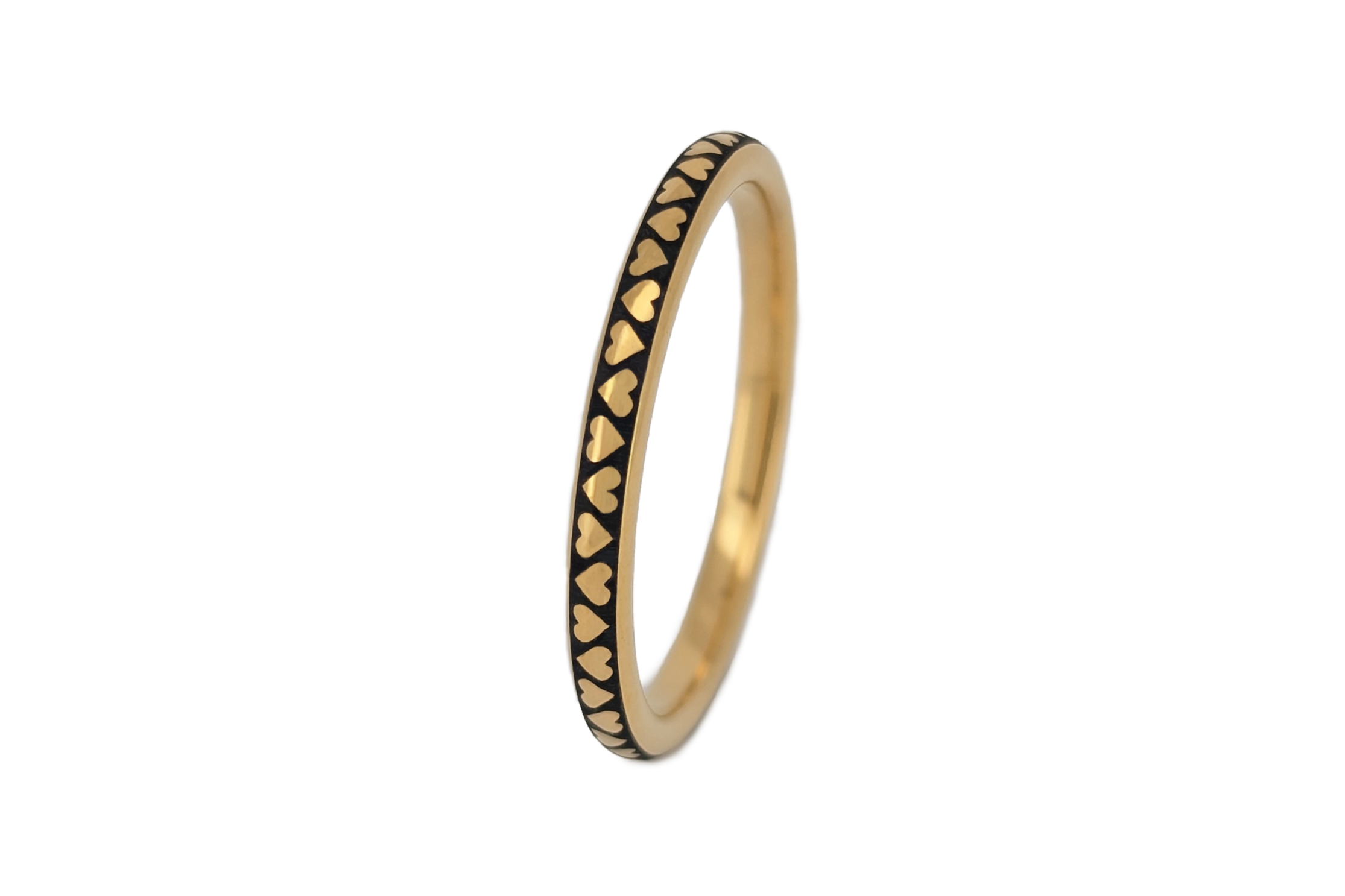
Tungsten carbide is exceptionally hard, highly resistant to scratching and able to retain a smooth, polished surface through years of everyday wear.
For HoloRing, that hardness has another important purpose. We create our designs directly in the surface with a laser, from classic engraving to microscopic structures that split light into color on selected holographic rings.
The effect is not paint or print applied on top. Tungsten carbide gives us a stable foundation for precise detail and exceptionally durable engraving.
That same hardness naturally raises a question: what happens if the ring ever needs to be removed quickly?
A common misconception
“A tungsten ring cannot be removed in an emergency.”
A standard ring cutter designed for gold or silver is not the right tool for tungsten carbide. That does not mean the ring has to remain on the finger.
Under sufficient, controlled pressure, it fractures instead of bending significantly. This can make professional removal surprisingly quick.
See the material behave
Watch how emergency removal actually works
The video demonstrates the behavior of the material. It is not a guide to treating an injured or swollen finger at home.
Why it works
Two sides of the same material property
Tungsten carbide is exceptionally hard. Unlike softer metals, it does not deform significantly under heavy load. Once its limit is exceeded, it fractures rather than continuing to bend.
The property that protects the ring's surface in daily wear therefore enables a different method of emergency removal from the one used for gold or silver.
Softer, ductile metals can usually be divided with a conventional ring cutter.
The very hard material bends very little and breaks under targeted compression.
What about other materials?
Different material, different removal method
Extreme hardness does not make tungsten impossible to remove. It means that the method must match the material.
Gold
Ductile and relatively soft. It deforms under pressure and can usually be divided with a conventional ring cutter.
Silver
Like gold, it is softer and generally responds well to tools designed for cutting rings from ductile metals.
Stainless steel
Stronger than gold or silver. Cutting may require a more suitable tool and more time.
Titanium
Strong and resistant to deformation. Standard manual cutters may not be sufficient, and the method depends on the ring's construction.
Tungsten carbide
Its hardness is not overcome by ordinary cutting. Published methods use controlled pressure and the material's characteristic fracture behavior.
This is not a safety ranking. Any rigid ring can restrict circulation if a finger swells significantly, and every material requires an appropriate removal method.
Published evidence
What does the medical literature say?
Controlled fracture is not based on a demonstration alone. It has been described in biomechanical testing and clinical practice.
The ring was fractured using locking pliers, and the patient's finger recovered fully.
View source ↗ American Journal of Emergency Medicine · 2013A comparison of two removal techniquesBoth methods succeeded in a model study. Controlled fracture was substantially faster, but protection from sharp fragments is essential.
View source ↗If a ring ever needs to come off
Act early and stay calm
-
01
Do not wait for severe swelling
If a ring can be removed normally and without force after an injury or at the first sign of swelling, take it off as soon as possible.
-
02
Seek help when warning signs appear
Pain, numbness, discoloration, injury or rapidly increasing swelling require professional assessment.
-
03
Tell the clinician what the ring is made from
Explain that it is tungsten carbide so the appropriate method can be chosen without losing time.
What not to do
Do not try to treat an injured finger at home with grinding or high-speed cutting. These methods can generate dangerous heat and require specialist equipment and protection of the surrounding tissue.

Back to everyday wear
What does this mean in daily life?
Very little. Tungsten carbide is exceptionally well suited to rings worn every day.
It resists ordinary wear and scratching extremely well. It is still worth distinguishing everyday contact from an unusually strong, concentrated impact against another hard object.
Made for ordinary wear
Daily work, travel, normal contact with your surroundings and long-term wear.
Avoid extreme impacts
A fall onto tile or concrete, a hard strike against metal, deliberate hardness testing or a forceful collision between two tungsten rings.
Why HoloRing uses tungsten carbide
A durable foundation for precise work with light
A hard, stable surface is ideal for fine laser engraving, precise patterns and a clean appearance that lasts. On selected rings, we use a laser to create microscopic nanostructures that split incoming light into shifting colors.
The holographic effect is not a printed layer. It is created by the structure of the metal surface itself.
Frequently asked questions
Clear answers before choosing
Are tungsten rings safe?
Yes. In ordinary wear, the hardness of tungsten carbide is not itself a cause for concern. As with any rigid ring, however, it is important to act early after an injury or if the finger begins to swell significantly.
Can a tungsten ring be removed in an emergency?
Yes. Instead of being cut like gold or silver, it is generally removed professionally by controlled fracture under gradually increasing pressure.
Can a hospital remove a tungsten ring?
Emergency removal is described in medical literature. Always tell the clinician that the ring is tungsten carbide because it requires a different method from softer metals.
Can it be cut with a conventional ring cutter?
A manual cutter designed for gold or silver is usually unsuitable. Tungsten carbide is removed using a different principle.
Why can a tungsten ring fracture?
The material is exceptionally hard and deforms very little under heavy load. Once a certain load is exceeded, it fractures instead of continuing to bend.
Does that mean it breaks easily during ordinary wear?
No. Tungsten carbide is exceptionally durable in daily use. The main risk is an unusually strong, concentrated impact against another hard object.
What should I tell a clinician if the ring cannot be removed?
Say that the ring is made from tungsten carbide and that published medical literature describes controlled fracture rather than cutting with a conventional tool for softer metals.
References
Sources
- Moser A., Exadaktylos A., Radke A. Removal of a Tungsten Carbide Ring from the Finger of a Pregnant Patient. Case Reports in Emergency Medicine, 2016.
- Gardiner C. L. et al. A comparison of two techniques for tungsten carbide ring removal. American Journal of Emergency Medicine, 2013.
This article is for general information and does not replace individual assessment by a healthcare professional.